Hail season in Tulsa: when it hits and how to protect your car
For anyone in Tulsa who parks outside or drives through spring storms. We counted 30 years of federal storm records to show which months bring hail and how big it gets, then laid out how warnings reach you, where to put the car and what insurance pays for.
Sources re-checked .
Short answer
In Tulsa County, hail falls mostly from March through June and peaks in May, with a smaller run in October and November; our count of NOAA records finds about 8.6 hail days a year. Hail warnings come as severe thunderstorm warnings from NWS Tulsa, and the City's outdoor sirens do not sound for hail. When hail is forecast, the Oklahoma Insurance Department says to get the car into a garage or covered parking.
NOAA NCEI: Storm Events Database; NWS Tulsa forecast office; City of Tulsa: Emergency Sirens; Oklahoma Insurance Department: Wind and Hail
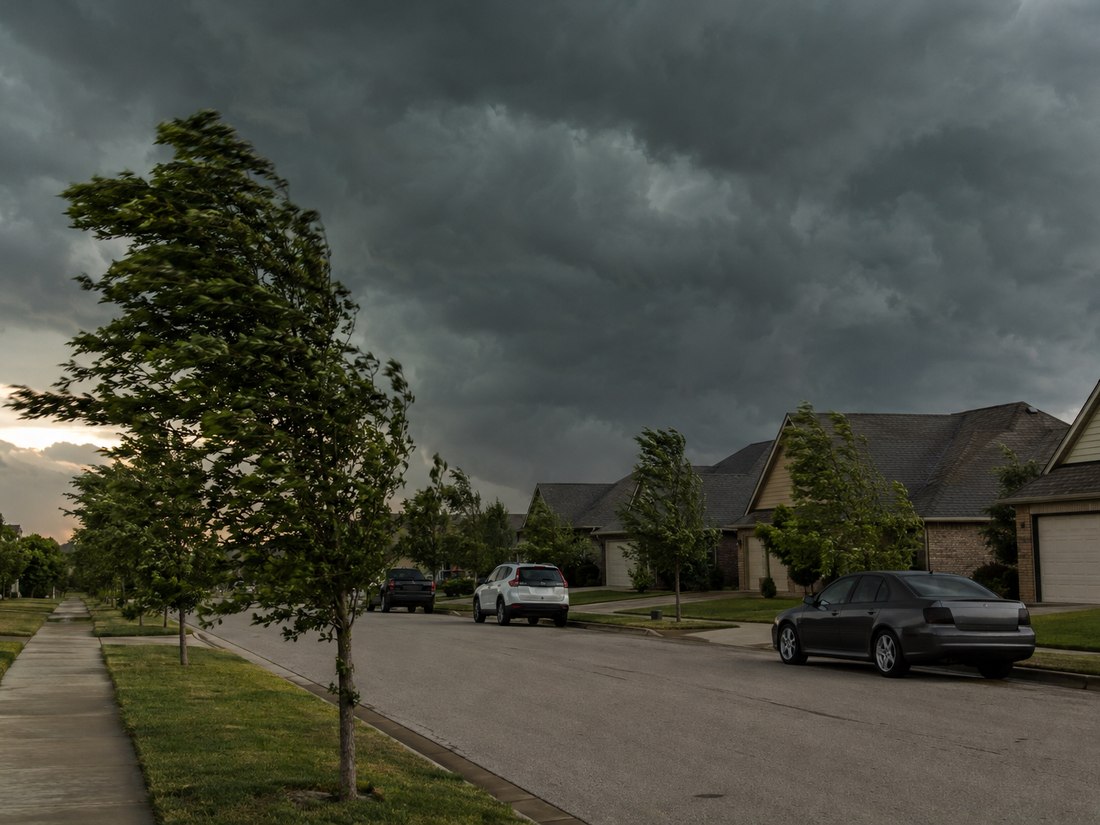
Which months bring hail to Tulsa County
This is our count of NOAA Storm Events records for Tulsa County, 1996-2025. NOAA logs hail as reports, each one a sighting at one place and time from the public, trained spotters, law enforcement, the media or an automated weather station. One storm can leave dozens, so the table counts hail days: dates with at least one report anywhere in the county. Over 30 years that came to 824 reports on 258 days, about 8.6 hail days a year. Golf ball-size means stones of 1.75 inches or more, the Weather Service's own yardstick.
| Month | Hail days, 1996-2025 | Average per year | Days with golf ball-size hail |
|---|---|---|---|
| January | 4 | 0.13 | 0 |
| February | 3 | 0.10 | 0 |
| March | 26 | 0.87 | 8 |
| April | 53 | 1.77 | 10 |
| May | 64 | 2.13 | 18 |
| June | 35 | 1.17 | 6 |
| July | 26 | 0.87 | 4 |
| August | 17 | 0.57 | 1 |
| September | 7 | 0.23 | 1 |
| October | 11 | 0.37 | 3 |
| November | 9 | 0.30 | 3 |
| December | 3 | 0.10 | 1 |
| All year | 258 | 8.6 | 55 |
- May is the peak. It holds 64 of the 258 hail days, about one in four, and 18 of the 55 golf-ball days.
- Spring carries the season. March through June account for 178 hail days, more than two-thirds of the total.
- Fall brings a smaller second run. October and November had 20 hail days between them, 6 with golf ball-size stones.
- Winter is quiet but not empty. December, January and February had 10 hail days combined in 30 years.
NWS Tulsa's own tally at Tulsa International Airport, 1950 through 1997, shows the same shape: hail in every month, a peak from mid-April to mid-May and a small bump in November.
Source: NOAA NCEI: Storm Events Database; NOAA NCEI: Storm Events bulk data files (our count, Tulsa County, 1996-2025); NOAA NCEI: Storm Data bulk CSV format (PDF); National Weather Service: damage threat tags and Wireless Emergency Alerts; NWS Tulsa: Tulsa hail climatology, 1950-1997.
How often hail hits one part of Tulsa
A county hail day does not mean hail hit your street. NWS Tulsa explains: “Since hail, by nature, is a fairly isolated event, it often occurs in one area of the city while completely missing another area, and vice versa.” From its airport records, the office put the odds for any single spot in the metro at hail two to three times a year on average, against about 8.6 hail days a year somewhere in the county.
Each NOAA record names a reference town: Tulsa on 234 of the 1996-2025 reports, Broken Arrow on 100, Owasso on 73 and Bixby on 64. A record exists only when a person or a station reports the hail, so this is not a ranking of which suburb gets hit hardest. For the same reason, this page does not use the yearly totals to judge whether hail is becoming more common.
Source: NWS Tulsa: Tulsa hail climatology, 1950-1997; NOAA NCEI: Storm Events Database; NOAA NCEI: Storm Events bulk data files (our count, Tulsa County, 1996-2025); NOAA NCEI: Storm Data bulk CSV format (PDF).
What time of day hail falls in Tulsa
Late afternoon is the busiest stretch. Of the 824 reports from 1996-2025, 291 came between 3 and 6 p.m. and 552, two in every three, came between 1 and 10 p.m. Those are local standard times: NOAA's format guide says its clock times are usually in LST. While daylight saving time is in effect, add an hour, so the 3-to-6 window reads 4 to 7 p.m. on your phone.
Hail after dark is in the record too. In all, 179 reports, more than one in five, came between 10 p.m. and 4 a.m. standard time.
Source: NOAA NCEI: Storm Data bulk CSV format (PDF); NOAA NCEI: Storm Events bulk data files (our count, Tulsa County, 1996-2025); NOAA NCEI: Storm Events Database.
The biggest hailstones and worst hail days on record
The largest stones in Tulsa County's full NOAA record, which reaches back to the 1950s, by NOAA's measurements:
| Date | Stone size | Place named in the record |
|---|---|---|
| May 10, 1963 | 4.50 inches | Not recorded |
| March 25, 2015 | 4.25 inches | Tulsa International Airport |
| March 27, 1997 | 3.75 inches | Tulsa |
| May 1, 2002 | 3.50 inches | Leonard |
| June 14, 1985 | 3.00 inches | Not recorded |
| August 1, 1986 | 3.00 inches | Not recorded |
| April 5, 2005 | 3.00 inches | Jenks |
| March 25, 2015 | 3.00 inches | Sand Springs |
| May 21, 2024 | 3.00 inches | Broken Arrow |
Stones that big are rare. Of the 824 reports from 1996-2025, 440 were 1 inch or larger, 131 reached golf-ball size, 12 reached baseball size (2.75 inches) and one measured 4 inches or more.
The two busiest hail days in 30 years were both recent
May 19, 2025 produced 44 reports, more than any other day from 1996 through 2025. Stones reached 2 inches, and reports came from Tulsa, Broken Arrow, Owasso, Jenks, Glenpool, Collinsville, Skiatook and Garnett. Six days later, May 25 added 21 more, with stones up to 1.75 inches.
May 21, 2024 ranks second with 40 reports. Its biggest stone, 3 inches, was logged at Broken Arrow at 4:55 p.m. standard time, with more reports from Tulsa, Bixby, Jenks, Glenpool, Owasso and Collinsville.
The county logged 58 reports on 10 days in 2024 and 82 reports on 9 days in 2025. NOAA's 2026 file, which so far runs through June, holds 30 Tulsa County reports on 6 days, the largest 1.75 inches.
Source: NOAA NCEI: Storm Events Database; NOAA NCEI: Storm Events bulk data files (our count, Tulsa County, 1996-2025); NOAA NCEI: Storm Events bulk download README.
How the National Weather Service warns Tulsa about hail
Large hail comes under a severe thunderstorm warning. The Weather Service sets the bar this way: “Severe thunderstorms are officially defined as storms that are capable of producing hail that is an inch or larger or wind gusts over 58 mph.” Hail that size, it adds, can damage roofs and vehicles.
- Watch: severe storms are possible in and near the watch area, which often spans many counties. Get ready.
- Warning: spotters have reported severe weather or radar shows it, and danger is imminent for an area about the size of a city. Act now.
Since August 2, 2021, a warning can carry a damage threat tag:
| Tag | Hail | Wind | Automatic phone alert? |
|---|---|---|---|
| Base (no tag) | 1.00 inch, quarter-size | 58 mph | No |
| Considerable | 1.75 inches, golf ball-size | 70 mph | No |
| Destructive | 2.75 inches, baseball-size | 80 mph | Yes |
Only the destructive tag sets off a Wireless Emergency Alert on phones in the warned area. In our 30-year count, 12 of Tulsa County's 824 hail reports reached baseball size, while 440 were an inch or larger. Most hail of the size the Weather Service says can damage vehicles falls below the phone-alert size, so do not count on Wireless Emergency Alerts for a quarter- or golf ball-size hail warning.
Source: National Weather Service: Severe Thunderstorm Safety; National Weather Service: Understand Severe Weather Alerts; National Weather Service: damage threat tags and Wireless Emergency Alerts; NOAA NCEI: Storm Events Database; NOAA NCEI: Storm Events bulk data files (our count, Tulsa County, 1996-2025).
Where Tulsa drivers get hail warnings
- NWS Tulsa, weather.gov/tsa. The forecast office at 10159 E. 11th St. posts current watches and warnings for Tulsa, its Hazardous Weather Outlook, and a form to submit a storm report.
- NOAA Weather Radio. NWS Tulsa lists Tulsa County's code as 040143, served by transmitters in Tulsa (162.550 MHz) and Bartlesville (162.425 MHz). A radio with SAME county coding can be set to that code.
- Your phone gets an automatic government alert only for destructive warnings.
- Not the outdoor sirens. The City's sirens have tones for tornadoes and chemical releases, nuclear attack and catastrophic flooding, not hail. The tornado tone sounds automatically when NWS Tulsa issues a tornado warning over part of the city, and the City describes sirens as meant for people who are outdoors.
- New emergency management offices. In June 2026 the City created its own Department of Emergency Management, which oversees the sirens, after “the dissolution of the Tulsa Area Emergency Management Agency (TAEMA)”. Tulsa County hired its own director the year before. For local weather updates, the City points residents to its social media and the National Weather Service.
- The Oklahoma Mesonet, run by the Oklahoma Climatological Survey, posts Storm Prediction Center maps of the average 1-inch and 2-inch hail days per year across Oklahoma, 1986-2015.
Tornadoes, flooding and ice storms each get their own advice on the storm season page.
Source: NWS Tulsa forecast office; NWS Tulsa: NOAA Weather Radio transmitters and county codes; NOAA Weather Radio: SAME county codes; City of Tulsa: Emergency Sirens; City of Tulsa: City of Tulsa Establishes Department of Emergency Management (June 18, 2026); City of Tulsa: Weather; Oklahoma Mesonet: Severe Weather Climatologies (1-inch and 2-inch hail days, 1986-2015).
Where to put your car when hail is forecast
The Oklahoma Insurance Department's first rule is a roof: “When hail or severe weather is forecast for your area, pull your car into a garage, covered parking lot or other protected areas.” Its storm guide says to move cars into a garage or carport as soon as a tornado watch is issued. With no covered spot, the department suggests a padded car cover or a hail protection blanket. Plan for any hour: two-thirds of Tulsa County's reports fall between 1 and 10 p.m. but about a fifth fall overnight, between 10 p.m. and 4 a.m.
If hail starts while you are driving
The Weather Service says a vehicle is safer than being outside in a severe thunderstorm, but to drive to the closest secure shelter if there is time. If there is not, the Insurance Department says to pull over somewhere safe, get completely off the highway and stay in the car until the hail stops.
Skip the highway overpass. NWS Norman studied the overpass deaths in Oklahoma's May 3, 1999 tornado outbreak and found that “Overpasses also offer questionable shelter from other severe weather phenomena.” In one example from that study, drivers near Dallas in 1994 stopped under I-20 bridges to escape golf ball-size hail and nearly brought the interstate to a halt. Cars parked at an overpass block the road and trap the drivers behind them.
Source: Oklahoma Insurance Department: Wind and Hail; Oklahoma Insurance Department: Prepare Now for Oklahoma Weather; National Weather Service: What to Do During Severe Weather; NWS Norman: Highway Overpasses as Tornado Shelters.
Does car insurance cover hail damage in Oklahoma?
Only if you carry comprehensive coverage. In the Oklahoma Insurance Department's words: “If you have comprehensive coverage, it may help pay to repair auto body, windshield and interior damage caused by hail.” Liability covers damage you do to others with your vehicle, not your own car. Oklahoma does not require comprehensive, and the department says minimum liability will not pay to repair or replace a car damaged in a storm. The state minimums are on the insurance page.
- Comprehensive may appear on your declarations page as Other Than Collision coverage.
- A higher deductible lowers the premium but raises what you pay on a claim. Before dropping comprehensive on an older car, the department suggests weighing the car's value and repair cost against the premium you would save.
The department also says to buy comprehensive well before you think you will need it. Tulsa County hail days start climbing in March, so check your policy in late winter.
After a storm, the claim and repair steps are on the after a hailstorm page, and what a hail claim can do to an Oklahoma title is on the hail, flood and salvage title page. For help with an insurer, call the department at 800-522-0071 or its Tulsa line, 918-295-3700.
Source: Oklahoma Insurance Department: Wind and Hail; Oklahoma Insurance Department: Prepare Now for Storm Season; Oklahoma Insurance Department: Choosing Your Automobile Insurance Policy.
Tulsa hail questions
When is hail season in Tulsa?
March through June, peaking in May. In our count of NOAA records for Tulsa County, 1996-2025, May had 64 of the 258 hail days and April had 53, with a smaller run in October and November.
Do Tulsa's sirens go off for hail?
No. The City's siren tones cover tornadoes, chemical releases, nuclear attack and catastrophic flooding. For hail, use NOAA Weather Radio, weather.gov/tsa or local news.
Will my phone warn me about hail?
Only for a destructive warning, meaning hail of 2.75 inches or wind of 80 mph. Warnings for quarter- or golf ball-size hail do not trigger an automatic phone alert.
Does liability insurance pay for hail damage to my car?
No. Comprehensive coverage is what may help pay for hail damage to your own car, and Oklahoma does not require it.
What is the biggest hail recorded in Tulsa County?
4.50 inches on May 10, 1963, with no place recorded. Since 1996, the largest was 4.25 inches at Tulsa International Airport on March 25, 2015.
More on selling a car in Tulsa
- PaperworkWhat you sign, who notarizes it, the two-day deadline, and which counter in Tulsa takes it.
- Cash for carsMoney for a running, dead or junk car anywhere in Tulsa: our offer or the partner route, paid by check.
- Bill of saleWhen Oklahoma needs a bill of sale, whether it is notarized, and what goes on it.
- Repair or sellCompare repair costs with the extra sale proceeds, then check Oklahoma's salvage and rebuilt title rules.
- After you sellPlate off, the two-day filing, insurance, PikePass, and what to do if a ticket arrives for a car you sold.
- Title problemsLost the title, a lien still on record, the owner has died, or the title is from another state.